

Security on the March
28mm Wargaming Scenarios Suggested by WW2 Training Videos

I am sometimes at a loss coming up with interesting and meaningful scenarios for larger figure-scale (in my case, this means 28mm) wargames. I have many books on wargame scenarios, but the bulk of these make more sense for battalion, or even brigade level games, and the remainder are usually ‘gang-fight’ skirmish scenarios. Sure, you can fight a holding action or simulate a deep raid into enemy territory with just a platoon or two, but these battles would usually be only a slice of the whole thing, and therefore difficult to say who ‘really’ won the battle.
A couple of days ago, while preparing for my forthcoming What A Tanker!-based seminar on WW2 tank warfare for my homeschool co-op, I found this excellent 1943 US Army training video on tank platoon security. I recommend watching the whole thing, as it should be of considerable interest to anyone interested in military history of that time period. I also invite you to compare its concise, clear presentation and engaging tone with any on-the-job training video you’ve been forced to watch in the last 25 years and consider its obvious superiority to all of them.
It also suggested some interesting scenarios for platoon-scale games. For each of the following scenarios, I am assuming the tank force is American and the opposing force is German, though there’s no reason they can’t be the other way around, or British, Soviets, Somuzan Cataphracts, 91st Armageddon or whatever. The scenarios are a framework, not rules specific, so you will have to adapt the circumstances to your chosen ruleset. I have not played these scenarios out, so you should not feel unduly burdened by sticking to my notes if they prove too easy/hard or don’t make sense to you.
Scenario I: Opposed Advance Through Hillcountry
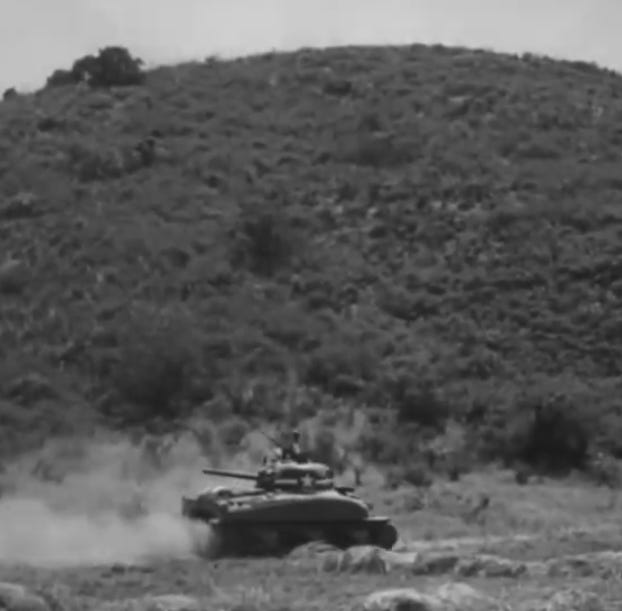
Beginning at around 9:30, the video warns against travelling atop hills because this gives the tank a clear silhouette against the sky which long-range gunners will take deadly advantage of. But what to do if you the hills are alive with enemy infantry?
Americans: 1 armored platoon of 5 tanks, plus any attachments. Any infantry must be motorized.
Germans: 1 platoon of infantry (on table) with at least one dedicated anti-tank team, 2 anti-tank guns (dug-in of table).
Table Setup: 6’x4’ (or lager), cross-country with at least 4 big hills and plenty of shrubs and trees scattered asymmetrically across the table, such the tanks should not be able to dash in a straight line to the opposite edge. At least two of the hills should be at least lightly wooded. Americans enter the table one tank at a time on a short end of the table. Germans began the game hidden in cover anywhere in the entire opposite half of the table.
Victory Conditions: The Americans must exit the opposite side of the table with at least half of their vehicles. Any other result is a German victory.
Special Circumstances: The American player must decide to stay at the base of the hills, exposing his weaker top armor to ambush from German panzerfausts, or try to flush them out, potentially exposing himself to fire from the hidden anti-tank guns off table. Each of the off-table German anti-tank guns may fire once per turn at any tank on top of a hill or more than half-way up or down it. This attack is resolved as direct fire at long range. Otherwise, they are restricted to indirect fire.
Scenario II: Air Attack During Column Advance
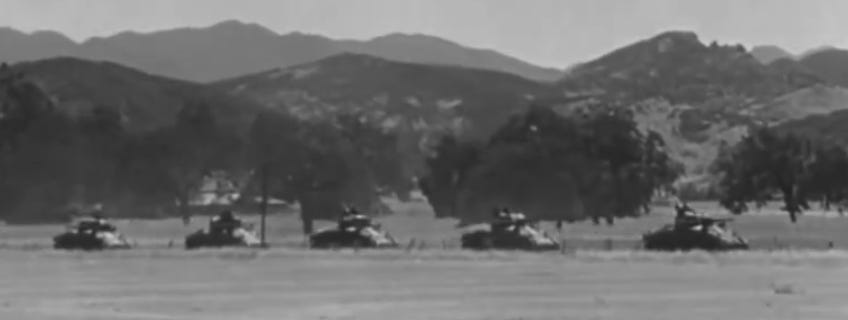
Around the 11 minute mark, the video warns against the dangers presented by bunching up during an air attack. In this mission, the American force is advancing along a road when it comes under fire from a small German force that can call an airstrike. The American player will be tempted to move all his tanks as far as they can go along the road to speed past the ambush, but this would cause them to bunch up and be a more inviting target for dive bombers. The German player must carefully decide when to spring his ambush, as he needs to give himself enough space to keep the Americans from quickly reaching the table edge but still maximize the utility of his air strikes.
Americans: 1 armored platoon of 5 tanks, plus any attachments. Any infantry must be motorized.
Germans: 1 platoon of infantry (on table) with panzerfausts and/or panzerschreck team, 1 forward air controller.
Table Setup: 6’x4’ (or lager), with a good quality road going mostly through the center of the table (a few curves are OK, but no sharp turns), from short edge to short edge. There are several hills marching across one long edge of the table and clumps of trees and rocks suitable to hide ambushing infantry elsewhere. At least two of the hills should be at least lightly wooded. Americans enter the table one tank at a time, in column, on a short end of the table. Germans began the game hidden in cover anywhere in the entire opposite half of the table.
Victory Conditions: The Americans must exit the opposite side of the table with at least half of their force. Any other result is a German victory.
Special Circumstances: The German air controller can call in one strike as normal during the game, but they also receive a free airstrike that comes in automatically after the turn when the first American tank reaches the midpoint of the table, targeting the lead operable tank. These fire missions can scatter as per the normal rules, with the exception that if a following tank (whether still in column or not) is within 8” of the target, those tanks are automatically hit. The tanks may fire at the aircraft if the commander exposes himself.
Scenario III: Attacked during Short Halt
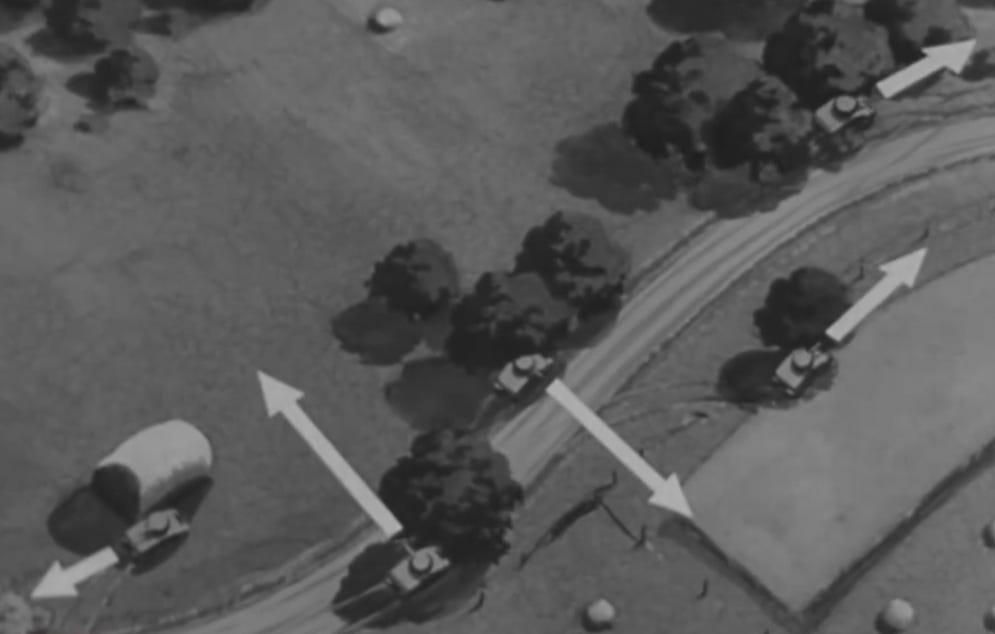
Around the 11:50 mark, the video talks about what should be done if a tank needs to fall out of formation for repairs. Then, around 17:10, it talks about security when a formation is during a short halt, which typically happened every two hours for about 10 minutes. In this scenario, the two situations are combined, with one tank having previously fallen out of formation and catches up during the short halt. Unfortunately, the rest of the column has come under attack by German recon elements who see the parked platoon as too juicy of a target to pass up.
Americans: 1 armored platoon of 5 tanks. Additional infantry models will be needed to represent disembarked tank crew.
Germans: 1 HQ, two squads of infantry (probably mounted), and two armored cars or light tank (suitable for a reconnaissance formation)
Table Setup: 6’x4’ (or larger), set up as close as you can to the image above, with an additional hill or small two-story building on each of the long sides of the table above the tanks. Four American tanks should be set up in cover, turrets turned in the appropriate directions, at least 12” from any other tank. This will cover a large amount of the board. All tanks are stopped with one crewman in the turret on lookout and the other three (or more, depending on the tank) dismounted and either doing maintenance or on guard duty. Two separate two-man sentry teams, made up of tank crew, are posted on the hill or building. The Germans enter the board from either of the long edges (determined randomly).
Victory Conditions: The Americans win if they can re-board their tanks and escape with at least half the platoon, or if they can drive off the Germans. The German force is only a scout element, so it will automatically withdraw if it takes 50% casualties or if they fail to win by the sixth turn (or equivalent).
Special Circumstances: The last tank in the platoon (the straggler who fell out earlier) must roll as reinforcements to enter the table, beginning on turn 2. When the roll is successful, the tank enters the table on the short end, along the axis of advance. If the alarm was already given, he can enter anywhere advantageous to him on that edge; otherwise, he will enter along the road.
Parked tanks can only move once at least two crew are embarked. If all crew are embarked, the tank can function as normal. If only three are embarked, it can only fire the main gun every other turn as the gunner must take up loading. Crewman from any tank can board any other tank to replace casualties, if necessary. If only two are embarked, it can only fire the main gun every other turn and is restricted to moving at normal combat speed (e.g. a ‘Move’ order in Bolt Action). If only the turret lookout is embarked, the tank cannot move and he can only fire the machine gun.
To start the game, only the American sentry teams or turret lookouts can detect enemy models. In games with strong observation or detection rules (this might make a good O200 Hours scenario), use them. Otherwise, assume the alarm is given whenever a) the Germans open fire, b) German infantry move out of heavy or light cover into line of sight of one of these sentries, or c) German vehicles move out of heavy cover.If any disembarked crew, including the sentry teams, are cut off from their tanks and not in cover, they will surrender to an enemy within melee charge distance.
To add more challenge to the game for the Americans, assume a 1 in 6 chance that one of the parked tanks requires some significant maintenance, like being in the middle of a track replacement. That tank is immobile for the duration.
The video suggests even more scenarios, so if you enjoyed this, let me know if I should write a follow up article. I would be greatly interested if you ran these scenarios yourself, especially in any changes or variations you felt suitable.
Great article. We need more of these. I just found Bruce Ivar Gudmundsson (https://tacticalnotebook.substack.com/), who is doing something similar on his substack. Not to mention his great series translating a German WW1 diary into english.
One of the things I like about What a Tanker is that spotting enemies is not automatic. Most wargames assume that you can see everything - which is especially ridiculous when you're talking about seeing from inside a tank.
Have you experimented with adding infantry to WaT?